The Shift from Keywords to Proof
A business can rank for the right keyword and still lose the customer. That is the part of modern SEO many companies feel before they can explain it. The page appears in search, the visitor lands on it, and nothing on the page makes the business feel more credible than the next option. In a search environment shaped by semantic understanding and AI summaries, being relevant is no longer the same as being convincing.
Trusting Advice from Best SEO Company Staten Island Offers
The real shift is not from keywords to AI, nor from SEO to some new acronym. The shift is from keyword coverage to proof. Keywords still help a business understand demand, organize pages, and match customer language, but a strong page also has to show why the business understands the problem, why the answer is useful, and why the reader should trust the company behind it.
Search Now Reads the Problem Behind the Phrase
Keyword research still matters because it reveals how people describe what they need. The mistake is treating the phrase as the whole strategy. Google has spent years explaining that its systems use AI models such as RankBrain, neural matching, and BERT to understand concepts, whole pages, whole queries, and word relationships. Google also says 15% of daily searches are new, suggesting many searches do not cleanly fit into old keyword lists. That changes the job of a page from matching a phrase to answering the business problem behind that phrase.
A customer searching for “SEO Company Staten Island” might be ready to hire. Another customer might search “why is my website not getting leads” or “why did my Google rankings drop.” The language changes, but the concern is often the same: something online is not producing business value. A strong SEO company on Staten Island knows that a page connects those different searches to the same underlying problem without sounding like a keyword template.
AI Search Makes Weak Relevance Easier To Ignore
AI search did not make SEO irrelevant. It made weak SEO easier to see. Google’s generative AI search guide says AI Overviews and AI Mode still rely on core Search ranking and quality systems, and it describes retrieval-augmented generation and query fan-out as ways Google pulls information from indexed content. That matters because the foundation is still web content, but the content has to stand up in a search experience where the user may see a synthesized answer before choosing a site. A page that merely repeats common knowledge has less reason to earn a click or keep a reader.
The click itself is under more pressure as well. Pew Research Center studied 900 U.S. adults and 68,879 unique Google searches from March 2025, and found that users clicked a traditional result in 8% of visits when an AI summary appeared, compared with 15% when no AI summary appeared. Pew also found that users clicked links inside AI summaries in only 1% of visits, and sessions ended more often after an AI summary appeared. Those findings do not mean websites stopped mattering. They mean each visit has to do more work once someone reaches the page.
The Old SEO Page Answers Too Little
Many business websites still follow the same pattern. They build a service page, add the target city, repeat the service phrase, and publish a short explanation of why the service matters. From a distance, it looks like SEO. Up close, it often gives the reader no real reason to believe this business understands the job better than anyone else does.
That is why proof is the better framing. Google’s helpful content guidance asks whether content provides original information, research, analysis, or substantial value compared with other search results. The practical business point is simple: useful pages should contain something the reader would miss if the page disappeared. If the page only repeats the definition of a service, it has not done enough.
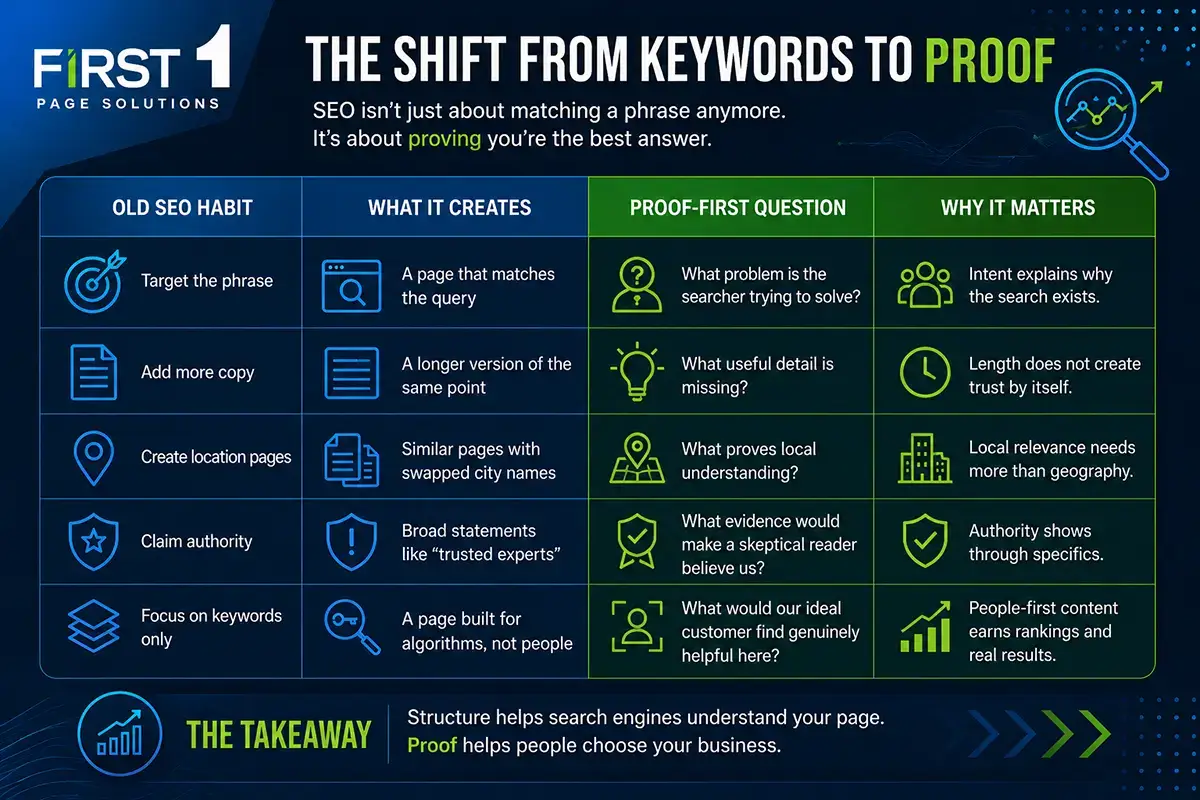
A focused review of a page should separate keyword coverage from proof. The difference is not academic. It determines whether a page only attracts a visit or helps the visitor move toward trust.
| Old SEO habit | What it creates | Proof-first question | Why it matters |
| Target the phrase | A page that matches the query | What problem is the searcher trying to solve? | Intent explains why the search exists. |
| Add more copy | A longer version of the same point | What useful detail is missing? | Length does not create trust by itself. |
| Create location pages | Similar pages with swapped city names | What proves local understanding? | Local relevance needs more than geography. |
| Claim authority | Broad statements like trusted experts | What evidence would make a skeptical reader believe us? | Authority shows through specifics. |
The point is not to abandon SEO structure. A page still needs a clear topic, useful headings, internal links, crawlable content, and language that matches search demand. The point is that structure does not replace substance. The business has to add the proof that a keyword tool cannot supply.
Brand Proof Is Not Branding Language
Brand proof is the evidence on the page that makes the company feel credible. It is not the logo, tagline, color palette, or a sentence saying the company is trusted. It is the service knowledge, local context, decision support, and judgment that make the reader believe the business has handled this problem before. For a contractor, that might come from explaining what usually goes wrong before an estimate. For a medical practice, it might come from setting expectations clearly before treatment. For a digital marketing company, it might come from explaining why rankings, traffic, and leads do not always move together.
This is the kind of material that generic pages usually lack. A basic page can explain what a service is. A proof-first page explains what the reader needs to understand before choosing a provider. That difference matters because customers are not only searching for information. They are evaluating whether the business sounds capable enough to contact.
The proof should match the buying decision. A page built for a reader with some SEO knowledge should not explain only definitions. It should help that reader understand the next layer of the problem.
- What the customer is likely misunderstanding before they call.
- What separates a weak solution from a stronger one.
- Where local competition changes the strategy.
- Which signs show the current page is ranking but not converting.
- What tradeoff the business owner should understand before spending more.
These details give the page a reason to exist. They also make the business easier to trust because the content feels connected to real decisions. A page built this way does not need to shout that the company is an expert. It shows expertise by clarifying the problem.
Existing Pages Are Often the Best Place to Start
Many businesses do not need a larger content calendar first. They need to improve the pages that already affect revenue. A service page with traffic but weak inquiries is often more important than another basic blog post. A local page with no proof is often more urgent than another location page. A ranking page that doesn’t generate qualified leads needs stronger decision support, not just more words.
This is where the strategy becomes more disciplined. The work is not “publish more.” The work is deciding which pages matter, which pages answer the wrong question, and which pages fail to prove enough. For a business owner who already understands SEO, that is the next level of the conversation. Visibility is useful only when the page creates enough confidence to support action.
Partner with a Leading SEO Company Staten Island
SEO is not moving away from keywords, but it is moving away from pages that depend on keywords alone. Search systems better understand intent, AI summaries change how users navigate results, and generic pages have less room to persuade. The businesses that adapt will not be the ones publishing the most pages. They will be the ones turning their experience, local knowledge, process, and judgment into content that proves why they deserve the lead. The useful question is no longer whether a page uses the keyword. The useful question is what the page proves that a basic answer or competitor page does not.