What are you doing for SEO on Staten Island?
The sales pitch lands because it speaks to a real frustration. Marketing costs money, agencies move slowly, reports can feel disconnected from revenue, and every business owner has wondered why so much work is needed to publish a page, send an email, or post on social media. Therefore, when an AI app promises to replace the team, automate the content, and make the whole machine cheaper, the offer sounds like relief. It also skips the hardest part of marketing.
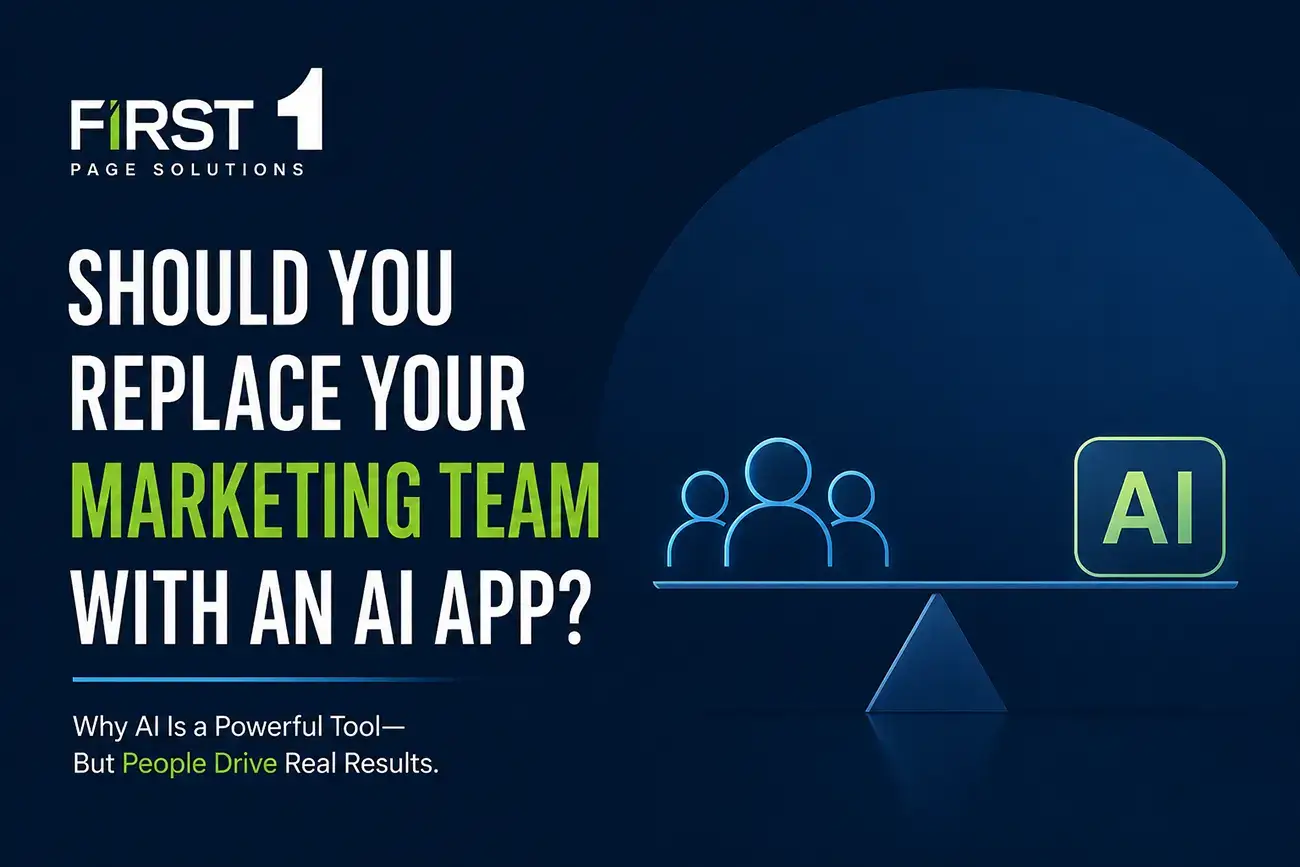
The real question is not whether a business should use AI. It should. The question is whether AI should replace the people responsible for strategy, accuracy, positioning, source control, customer understanding, and results. AI is valuable when it speeds up a guided process, but it becomes risky when the software produces output faster than the business can verify whether the work is accurate, useful, and tied to revenue.
SEO Staten Island must be led by humans that understand your business and the constant change from AI and Google
The Easy Part of Marketing Is Not the Whole Job
AI apps are good at producing visible assets. They can draft posts, summarize notes, outline pages, rewrite service descriptions, and create variations quickly. That kind of help has real value when the business already knows what it needs to say and why. The mistake is confusing output with strategy.
Most businesses do not have a content problem by itself. They have a lead quality problem, a positioning problem, a trust problem, a conversion problem, or a weak offer problem. A tool can create a page, but it does not know which service has the best margin, which lead types waste time, which claims need proof, or which customer objections stop someone from calling. Those are business decisions, not writing tasks.
Google Does Not Reject AI, but It Does Reject Low-Value Work
A responsible answer has to start with what Google has actually said. Google’s guidance on AI-generated content emphasizes content quality rather than how it was produced, and it says the appropriate use of AI or automation is not against its guidelines when the purpose is not to manipulate rankings. That should stop the panic that AI content is automatically bad. The real risk is using AI to publish weak work at scale and calling that a marketing plan.
Google’s spam policies make the risk more concrete. SEO Staten Island shouldn’t start from that. The policies define scaled content abuse as creating many pages primarily to manipulate rankings rather than to help users, and they include examples such as generative AI pages that add little value, stitched content, and keyword-filled pages that offer readers little value. The lesson for business owners is direct: automation does not turn low-value work into useful marketing. It only makes the low-value work appear faster.
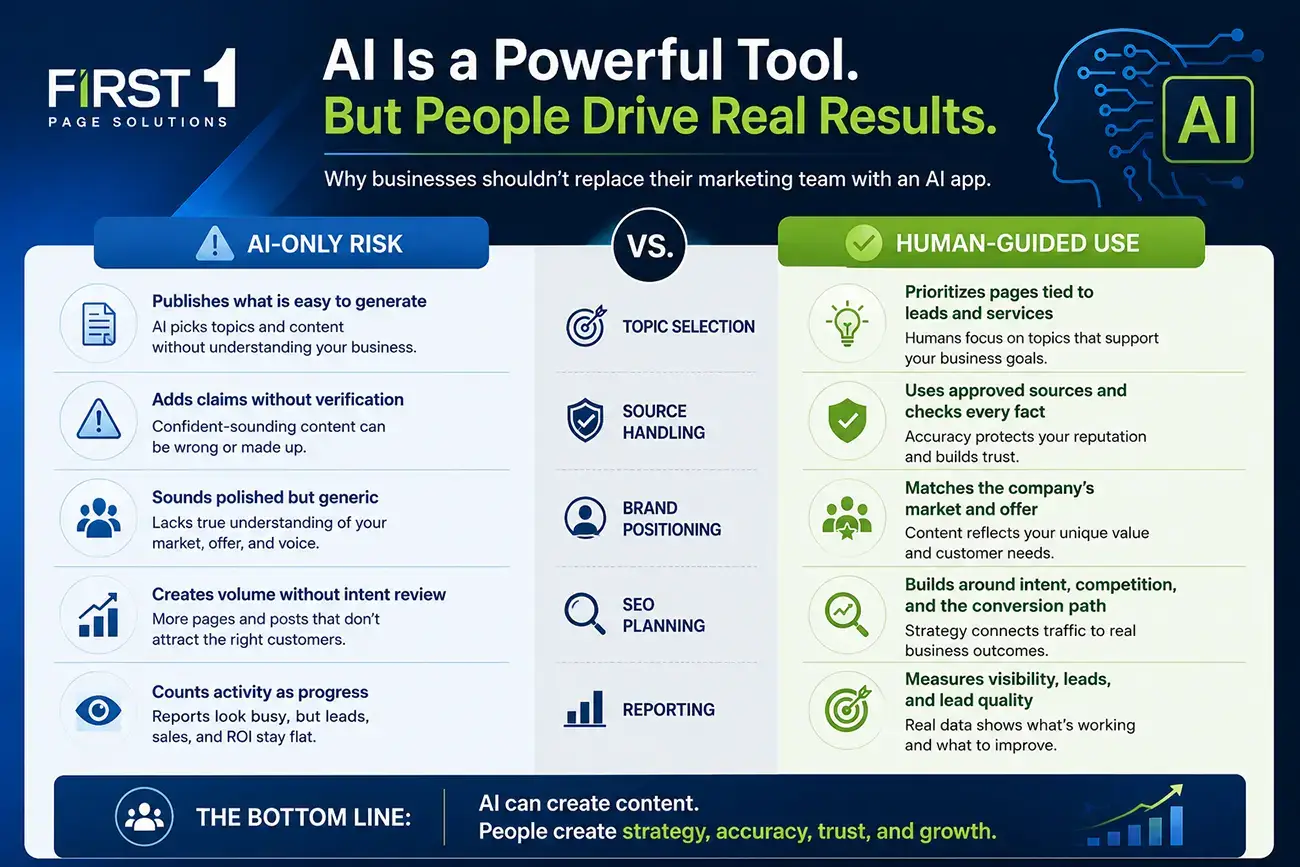
The difference between a useful AI workflow and a risky one usually becomes apparent before anything is published. The tool is less important than who decides the purpose, checks the claims, and owns the result.
| Marketing decision | AI-only risk | Human-guided use | Business reason |
| Topic selection | Publishes what is easy to generate | Prioritizes pages tied to leads and services | Not every topic deserves budget. |
| Source handling | Adds claims without verification | Uses approved sources and checks every fact | False confidence damages trust. |
| Brand positioning | Sounds polished but generic | Matches the company’s market and offer | The content must represent the business. |
| SEO planning | Creates volume without intent review | Builds around intent, competition, and conversion path | Traffic without fit is weak value. |
| Reporting | Counts activity as progress | Measures visibility, leads, and lead quality | Output is not the same as performance. |
This comparison shows why a business should not evaluate AI solely by speed. Speed matters when the direction is right. When the direction is wrong, speed creates more cleanup, more weak pages, and more assets that do not support revenue.
AI Errors Often Look Finished
The danger with AI output is not that every answer looks rough. The danger is that many answers look polished before anyone checks them. A confident paragraph can contain an invented statistic, a wrong process, an unsupported claim, or a citation that does not say what the content says it says. That matters because marketing copy often becomes the public record of what a business promises.
The legal field has already shown what happens when fluent output is mistaken for verified work. In Mata v. Avianca, a federal court sanctioned attorneys after filings included non-existent cases and fabricated legal citations generated through ChatGPT. That is a legal example, not a marketing example, but the business lesson transfers: polished language does not prove accuracy. If no one checks the work, the error becomes part of the business’s public-facing material.
Research on legal hallucinations reinforces the same workflow problem. A Stanford-affiliated study found that general-purpose language models produced hallucinations between 58% and 88% of the time when asked specific, verifiable legal questions about federal court cases. Those numbers should not be treated as marketing error rates because the test was legal-specific. They still show why verification matters whenever the content carries factual, reputational, or compliance risk.
A Good Team Uses AI Differently
The answer is not to avoid AI. A marketing team that refuses to use AI will waste time on tasks that software can automate. The stronger answer is to use AI inside a controlled process. That process starts with the business goal, the audience, the offer, the source material, and the conversion path before the first draft begins.
This is where human guidance changes the tool’s value. AI can help organize notes, compare angles, test headlines, summarize research, and create first drafts. People still need to decide what matters, whether the claim is accurate, whether the content reflects the business, and whether the final piece should be published. The tool can accelerate production, but it should not become the owner of judgment.
A practical AI-assisted process keeps the repetitive work in the tool and the accountable decisions with people. That keeps the business from confusing automation with strategy.
- Use AI to organize approved research, not invent source material.
- Use AI to draft from a clear brief, not decide the strategy alone.
- Use AI to compare structure options, not choose the revenue priority.
- Use AI to edit for clarity, not approve factual claims.
- Use AI to summarize reporting, not interpret lead quality without context.
This is the workable middle ground. It gives the business speed without giving up control. It also makes the marketing team more accountable because the process must explain where AI helps, where human review occurs, and how performance is measured.
The Warning Sign Is a Promise with No Process
AI marketing offers are not all bad. Some tools are useful, and some agencies use AI responsibly. The warning sign is not the presence of AI. The warning sign is a promise that the business can remove the people who understand strategy, customers, and accountability without losing anything important.
Google’s guidance on third-party SEO tools and advice tells site owners to check outside claims against official Google documentation, and it reminds businesses that Google does not evaluate third-party services or guarantee results from any tool or vendor. That matters more now because AI has created a market for confident claims around AI visibility, GEO, and automated SEO. A trustworthy provider should explain the process, the limits, the review steps, and the performance measures in plain terms.
A business owner does not need to become an AI expert to evaluate the offer. The useful questions are business questions.
- Who decides which services and pages matter most?
- Who checks the sources and claims before publishing?
- Who reviews whether the content matches the business and market?
- Who measures whether the work produced qualified leads?
- Who takes responsibility when the output is wrong or weak?
If the answer is only the software, the business is buying output without accountability. That may look efficient at first. It becomes expensive when the content is wrong, generic, unsupported, or disconnected from revenue.
The Conclusion for Business Owners
Do not replace your marketing team with an AI app just because it can produce more output. Use AI to reduce repetitive work, speed up drafts, organize research, and improve the process, but keep people responsible for strategy, accuracy, positioning, and performance. Google’s own guidance supports this middle path because it focuses on helpful content and warns against scaled low-value work, not the responsible use of AI itself. The businesses that win with AI will not be the ones that remove judgment from marketing. They will be the ones that make judgment faster, sharper, and easier to apply. AI should make the team better, not become the team.