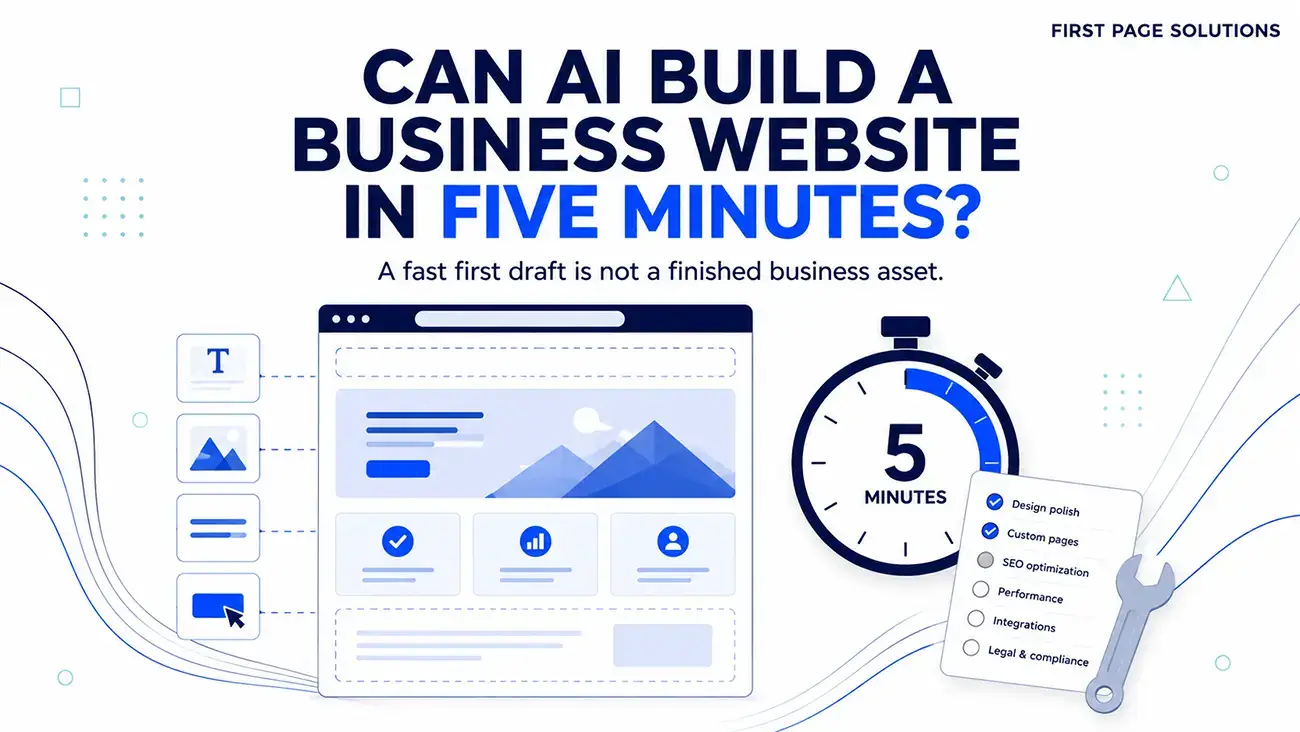
Any SEO company Staten Island businesses hire should explain the difference between generating a website and finishing one. AI can produce a homepage, service sections, images, headings, contact forms, and a responsive layout in five minutes. Some tools can do it even faster. That speed makes the technology useful, but speed alone does not determine whether the resulting website can support a business.
The misleading part begins when someone presents the generated result as a finished website or an easy product to resell for hundreds or thousands of dollars. AI can make something that looks and sounds like a website almost immediately. It cannot learn everything the business needs, verify its own decisions, and assume responsibility for what happens after launch in the same five minutes. The difference between those outcomes sits outside the initial generation process.
Where the Five-Minute Website Promise Comes From
AI website platforms openly compete on speed and simplicity. Durable advertises a complete website generated in approximately 30 seconds, while Wix and Lovable promote business websites created within minutes. Those claims describe a real technical capability. Modern systems can combine familiar layouts, generated copy, and standard business features much faster than a developer could assemble them manually.
Creators have turned that capability into a simple social-media sales formula:
- Find a local company with an outdated or missing website.
- Copy information from its website, Google Business Profile, and reviews.
- Feed those materials into an AI website builder.
- Present the generated design as work worth thousands of dollars.
- Sell the process as an easy business that requires little technical knowledge.
Some demonstrations follow that sequence almost exactly. One creator video hosted by Lovable rebuilds an electrician’s website from existing business information and two prompts. The finished screen looks cleaner and more modern than the original, which makes the demonstration persuasive. It doesn’t show whether the new site reflects the company’s priorities, ranks for relevant searches, converts visitors, or works correctly after deployment.
That gap creates the hype. Viewers see a dramatic visual transformation compressed into a short video, but they don’t see discovery, content development, integrations, testing, or maintenance. The creator can truthfully say that AI generated the design in minutes. The false implication is that the generation completed every other part of the project.
What Can AI Actually Produce in Five Minutes?
AI can generate a useful foundation. It can write code, organize common page sections, suggest headings, establish colors and typography, create interface components, and make routine responsive adjustments. A capable operator can also provide screenshots, content requirements, and technical constraints that improve the first result. These abilities can remove hours of repetitive production work from a legitimate website project.
The initial output still reflects the information and instructions available to the system. A short prompt produces a generalized interpretation of what a business in that industry probably needs. A detailed brief can produce something much closer to the intended website, but developing that brief requires the strategy that the five-minute sales pitch removes. The resulting page therefore proves that the software can assemble website components, not that the business has completed its website.
| Five-minute output | Finished business website |
| Generated headings and general service copy | Verified positioning, claims and service priorities |
| Familiar page sections | Architecture based on search intent and customer needs |
| Responsive-looking layout | Tested behavior across actual devices and browsers |
| Standard contact form | Working delivery, validation, spam control and conversion tracking |
| Basic metadata or SEO settings | Researched page targeting, internal links and measurable search strategy |
| Publishable preview | Controlled domain, hosting, accounts, backups and maintenance plan |
The table does not mean every website requires months of custom development. A simple local-business website may need a modest page count and limited functionality. It still needs accurate information, intentional decisions, and verified performance. AI can shorten the production timeline without removing those requirements.
1. The AI Starts With Almost No Business Knowledge
A Google Business Profile can provide a company name, category, address, phone number, and basic service information. An existing website may supply additional copy, images, and customer reviews. Neither source necessarily explains why customers choose the company, which services create the best opportunities, or what questions prevent prospects from calling. The AI fills those gaps by predicting what a business of that type usually says.
That prediction produces polished but interchangeable language. A plumber, electrician, or contractor may receive the same broad claims about quality, reliability, and customer service that appear across thousands of competing websites. The statements can sound appropriate while communicating nothing distinctive. Generic copy creates the appearance of completeness without giving customers a reason to select the business.
Before the site structure can support marketing or sales, the project needs information that public listings rarely provide:
- Priority services and services the company does not want to emphasize
- Profitable customer types, job sizes and geographic markets
- Common objections, misconceptions and pre-sale questions
- Verifiable differentiators, certifications and operating capabilities
- The desired action for visitors at different stages of their decision
- Legal or internal restrictions on claims, warranties and guarantees
The same limitation affects headings and page architecture. AI can insert an H1, but it cannot determine the correct search intent without research and business context. It can create service pages, but it does not inherently know which services require separate coverage, which locations justify dedicated pages, or where several pages would compete for the same search intent. Human direction must convert the generated structure into one that reflects the actual business.
Google’s guidance supports this distinction. The company does not object to content simply because AI helped create it. It warns against generating pages without adding original value for users. The relevant question is therefore not whether AI wrote the first version, but whether anyone supplied the knowledge that made the final version specific, accurate, and useful.
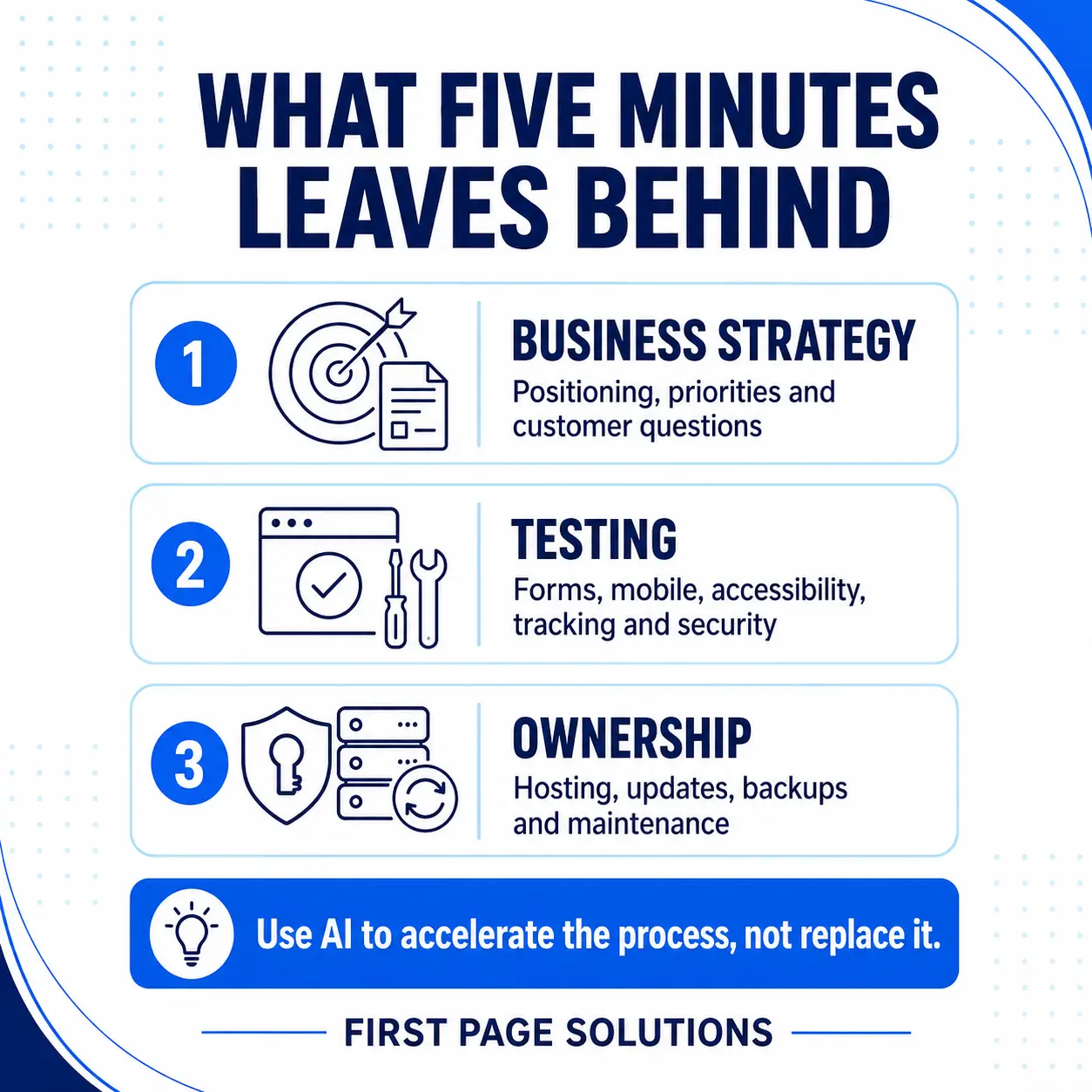
2. A Website Can Look Finished Without Being Tested
A homepage can look credible while its contact form fails, mobile menu breaks or conversion tracking records nothing. It may also contain inaccessible headings, weak color contrast, missing labels, or keyboard-navigation problems that a quick visual review does not reveal. Smooth animations and modern layouts cannot compensate for a customer being unable to complete the intended action. Appearance provides only one category of evidence.
Academic researchers have already documented accessibility problems in generated websites. One 2025 study identified hundreds of accessibility errors across a small sample of AI-generated sites, while another evaluation found problems involving alternative text, heading structure, keyboard navigation, and interactive labels. Those studies do not prove that every AI-generated website fails. They demonstrate why generation cannot replace evaluation.
A business website needs testing appropriate to its actual features and risk:
- Forms: Confirm successful delivery, required fields, validation, spam controls, and failure messages.
- Mobile behavior: Test navigation, buttons, text, images and interactive elements on real screen sizes.
- Accessibility: Review keyboard access, headings, labels, alternative text, contrast and focus behavior.
- Measurement: Verify analytics, advertising conversions, call tracking, and consent behavior.
- Performance: Check loading behavior, image delivery, and layout stability under realistic conditions.
- Security: Review dependencies, configurations, data handling, credentials, and exposed functionality.
- Integrations: Test scheduling tools, payments, email systems, customer platforms, and third-party services.
These checks require judgment because not every website has the same failure paths. A brochure site with one contact form does not require the same security review as an e-commerce store that processes payments and customer accounts. However, both sites need someone to verify the functions they do contain. The testing scope should follow the site’s actual purpose rather than how quickly AI created its interface.
W3C states that automated tools alone cannot determine whether a website meets accessibility requirements. NIST and OWASP likewise describe software and web security verification as structured processes, not assumptions made after a successful build. Even official OpenAI guidance tells users to provide constraints, run project checks, review the deployment, and continue correcting the live result. The technology’s own recommended workflow extend well beyond the initial prompt.
3. Someone Still Has to Own the Website after Launch
A business website does not stop changing when the homepage goes live. Software receives updates, vulnerabilities emerge, services change, and integrations fail. Search behavior and advertising campaigns also change what the website needs to communicate. Someone must remain responsible for detecting and responding to those changes.
That responsibility begins with ownership. The business should know who controls the domain, hosting account, source code, analytics property, and connected services. It should also know whether it can transfer those assets without rebuilding the website. A low initial price provides little value if the company remains dependent on an unavailable seller.
Before accepting an AI-generated website, the business should ask:
- Who owns and controls the domain, hosting, and source files?
- Which platform subscriptions or usage charges keep the website operating?
- Who receives form submissions and monitors delivery failures?
- Who installs updates, maintains backups, and responds to security problems?
- Can another qualified developer take over the website without starting again?
These questions expose costs that the five-minute demonstration omits. The seller may have generated the initial design quickly while leaving the client responsible for every account, correction, and failure. In worse cases, the seller retains control and charges the business whenever it needs access or changes. A professional handoff should eliminate that uncertainty before launch.
AI can assist with ongoing operations. It can diagnose errors, prepare code updates, test changes, and accelerate routine maintenance. It cannot decide who is responsible or guarantee someone will notice when the system fails. The business still needs a defined owner for the website and its results.
Build a Website That Is Ready for Business
AI can speed up website production, but it cannot replace the strategy, testing, and accountability that make a finished site useful. A business still needs accurate content, working conversion paths, reliable measurement, and control of its digital assets. First Page Solutions can evaluate an existing AI-generated website or build a new site through a properly managed development process. We use AI where it improves efficiency while retaining human oversight at every consequential stage. Contact us to discuss a website that works for your business, not one that merely looks finished in a demonstration.