If a second service truck is ready to work next week, you have a different marketing problem from a company whose calendar is full but whose website barely explains its most valuable service. The first business may need a controlled way to reach prospective customers sooner. The second may need to improve how it is found and understood over time. Neither situation makes SEO or Google Ads the automatic winner.
At First Page Solutions, we believe in internet marketing Staten Island. We start with the work you want to book, the capacity to deliver it, and the budget available to acquire it. Marketing agencies frequently frame this decision as a binary choice, claiming one channel is universally superior. In practice, however, organic search and paid advertising serve fundamentally different economic functions. A sensible starting point comes from your circumstances, not a claim that one channel is always cheaper or faster to profit.
Start with whether the business is ready for the inquiry
Picture an ad that attracts someone needing a service you provide, in an area you serve, at a time you have availability. That is promising, but the campaign still depends on the page explaining the service and the business responding. If calls go unanswered or the mobile form does not work, buying more traffic increases the opportunity to lose inquiries. These problems should be corrected before treating an advertising budget as the solution.
The same issue applies to SEO. More visibility is not particularly useful if the page leaves customers unsure whether you do the work or how to request it. A clear offer, accurate service area, usable contact path, and reliable inquiry handling support both channels. We therefore look at those basics alongside the search opportunity, not after the campaign has begun spending time or money.
When a focused Google Ads test makes sense
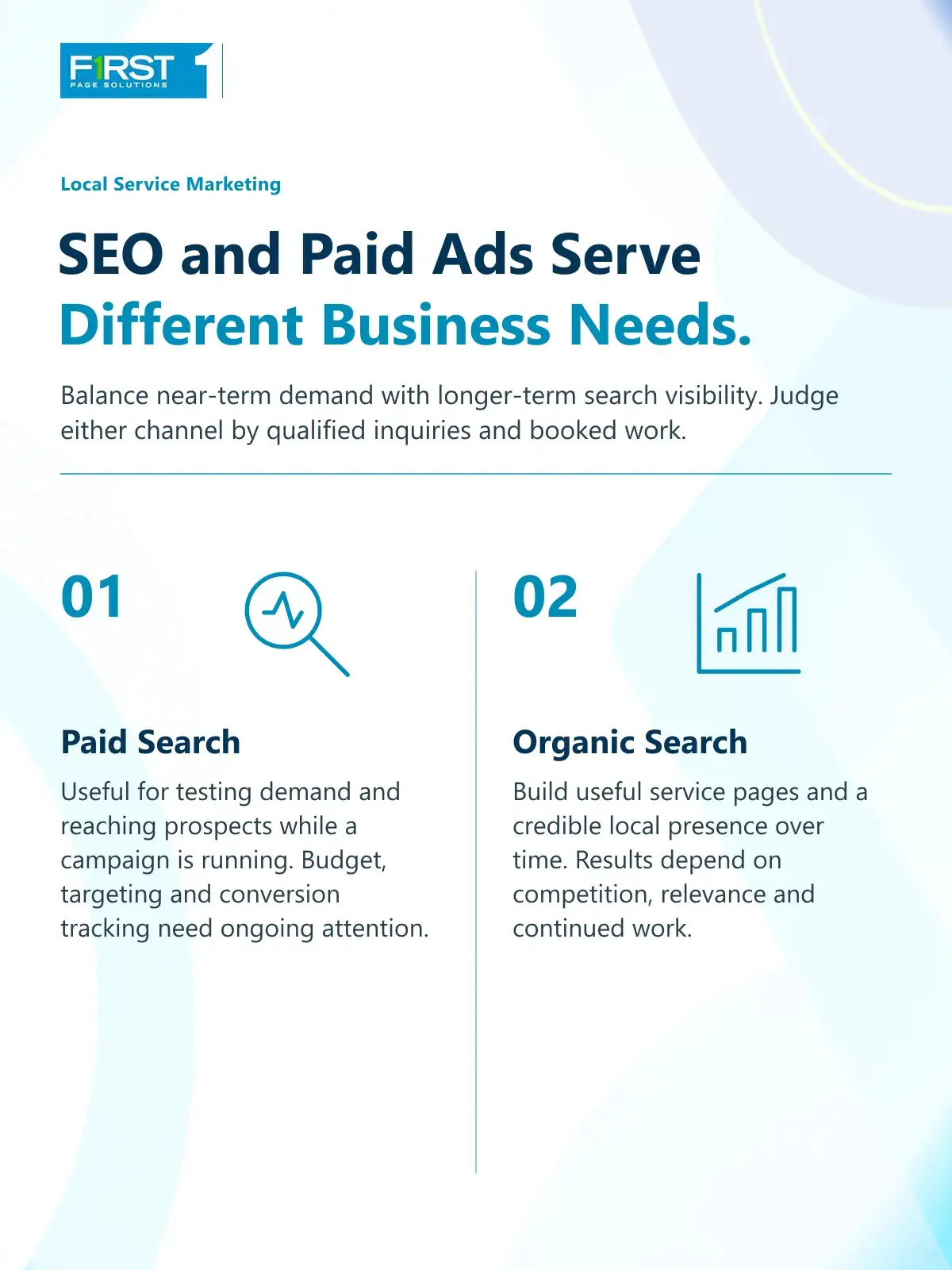
Paid search deserves consideration when you have a defined service to promote, capacity to take the work, and a budget you can evaluate against qualified inquiries and booked jobs. It lets you seek paid visibility without first waiting for an organic ranking improvement. But eligibility to advertise is not a guarantee of placement, calls, or profitable work. The campaign still needs suitable targeting, a relevant page, and ongoing review.
For example, a Staten Island contractor with room for a specific type of repair could test that service before advertising every offering across the metropolitan area. The useful outcome is not simply a count of clicks. It is whether inquiries concern the right service, fall within the actual service area, and become work the company wants. If those conditions are not met, the response may involve changing targeting, the offer, the page, or lead handling rather than increasing the budget.
Geography deserves particular attention here. A job across a bridge may be profitable for one company and impractical for another because of travel, scheduling, or service commitments. Google Ads location controls help guide targeting, but they do not create a perfectly accurate geographic fence. Review where inquiries are actually coming from and whether they fit your operating area.
When SEO should receive the initial attention
SEO is a strong candidate when the business needs its existing website and service information to do a better job over time. Perhaps a valuable service has little explanation, an important page is hard to find, or useful existing content no longer reflects the work you perform. Those are reasons to improve the site based on evidence, not reasons to publish a set number of new pages every month.
Organic search does not charge a fee for each click, but the work required to improve and maintain visibility still has a cost. Rankings and lead volume are not guaranteed. Local Maps visibility and ordinary website results also need to be distinguished rather than reported as though they are the same placement. Paying for Google Ads does not buy an improvement in Google’s organic rankings.
If you already receive useful inquiries from search, the first SEO opportunity may be to improve pages that are working rather than replace them. Understand what they currently attract, what the reader needs, and where the contact path falls short. A wholesale rebuild without that review can disrupt something useful while chasing a more impressive-looking site.
| Your immediate situation | Sensible starting discussion |
| Capacity is available, the offer is clear, and inquiry handling works | Consider a focused paid-search test with a defined budget and success criteria. |
| The site poorly explains services or has basic usability problems | Correct the relevant site and contact-path problems before scaling acquisition. |
| Existing search traffic is relevant but inquiries are weak | Investigate page fit, conversion friction, and lead handling rather than assume more traffic is needed. |
| Both channels already produce work | Compare qualified inquiries, booked jobs, and costs before reallocating effort. |
Choose a starting point you can evaluate
The internet marketing Staten Island businesses need should reflect their actual service capacity and economics. Decide in advance how inquiries will be recorded, who follows them up, and what makes a lead qualified. Then compare channels with those limitations in mind. A tracked form submission is not automatically a booked job, and an increase in clicks does not establish profitable growth.
Start with Google Ads when a focused paid test fits your readiness, capacity, and budget. Start with SEO and site improvements when weak service information or existing search performance is the more important opportunity. Use both when each has a defined role and you can support the work, rather than split a limited budget simply to say both are running.
Contact First Page Solutions with the services you want to grow, your available capacity, and what you currently know about inquiry sources and booked work. We can review the website and any existing advertising to recommend where the next effort should go. The decision should produce a manageable starting plan, not a promise of instant calls or permanent rankings.