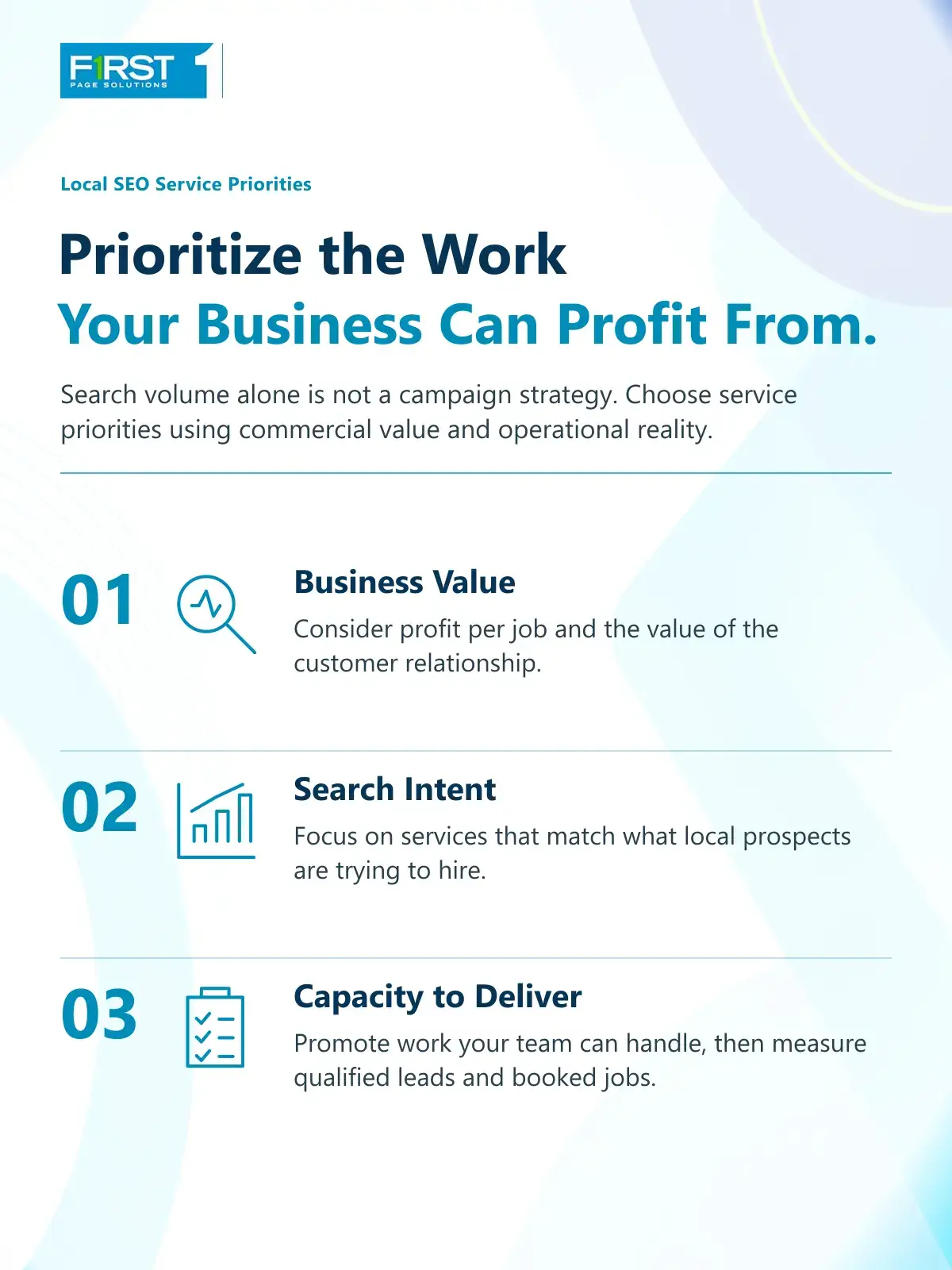
Your most expensive service is not necessarily the best first SEO target. A large project may offer attractive revenue but require a crew that is already fully booked. A smaller service may have dependable demand, available capacity, and a page that needs a manageable improvement. The right priority is the service where a realistic search opportunity overlaps with work the business can deliver profitably.
At First Page Solutions, we begin with that overlap before deciding which pages to create or revise. A keyword list can tell us what to investigate, but it cannot tell us your staffing limits, which jobs you want, or what makes an inquiry worthwhile. Those decisions need your business knowledge. Our role is to connect them with search evidence and the website you already have.
Start with the work you want and can accept
A roofing company may prefer replacement projects because of their value. But if its replacement crew is committed for the foreseeable future while repair capacity remains available, automatically putting every effort behind replacement is a questionable choice. The campaign should account for availability, seasonality, and the time needed to handle new work. A service is not a useful priority simply because it produces a large invoice.
For an HVAC company, seasonal maintenance or diagnostic calls may also have value even when the initial job is smaller. They should not be dismissed as inferior merely because a replacement is worth more. Equally, do not assume every maintenance visit becomes a major future sale. Use actual customer and job records where available, and label uncertain expectations as assumptions.
Before we prioritize services, useful questions include:
- Which work has capacity now, and which work needs a longer-term pipeline?
- Which services produce acceptable returns after labor, materials, travel, and follow-up?
- Where can the company reliably serve customers, and which inquiries are a poor fit?
- What project evidence, photographs, explanations, and qualifications can support the service page?
- Which services are already attracting useful inquiries through the site?
These questions prevent a search campaign from promoting work the office will turn away. They also reveal opportunities that a keyword-volume ranking would miss.
Compare demand with what the website already does
The SEO company Staten Island businesses choose should examine existing pages before prescribing new ones. A service might already have a useful page that attracts relevant searches but does not answer important buying questions. Another might be mentioned only in passing. Those situations call for different work, even if both services are commercially important.
Use search and website data to understand what queries and pages are already producing attention. Then connect that information with inquiry quality where records allow. High visibility for an irrelevant question is not the same as demand for the service you want to sell. A smaller number of relevant inquiries can be more useful than broad traffic, but the business records need to support that conclusion.
The search results themselves also help clarify what people appear to need. A query may call for a service provider, an explanation, or a comparison. That affects whether the next useful asset is a service page or supporting informational content. Do not force every query into a sales page or assume every related question deserves a separate blog post.
Give each priority a reason and a next action
Instead of labeling services “high value” and stopping there, record why a service should receive attention now. Separate the business opportunity from the work required on the website. A service can be commercially attractive while needing evidence or capacity the company does not yet have. That may make it a later priority without making it unimportant.
|
Service situation |
Possible priority |
Practical next action |
|
Good fit, available capacity, and an existing relevant page |
Improve now |
Check what the page is missing and whether its inquiry path works. |
|
Good fit, but little useful coverage or supporting evidence |
Develop deliberately |
Gather company facts and decide whether a distinct service page is warranted. |
|
Attractive work, but capacity is currently limited |
Plan for later demand |
Agree on timing and avoid promising availability the company cannot provide. |
|
Traffic is high, but inquiries are consistently unsuitable |
Reassess |
Check intent, service-area wording, and qualification before expanding content. |
These are planning examples, not a rule that every company must use the same four categories. The point is to make the tradeoff visible. When two services compete for limited effort, the choice should have a business reason and an evidence-based website action.
Do not create a new page for every keyword variation
A distinct service with its own customer questions may warrant a dedicated page. Slightly different wording for the same service may belong on the same page. The decision should follow the reader’s intent, the existing site, and whether the company has enough useful information to support a separate answer. Creating near-duplicate pages simply to assign each phrase its own URL can add confusion without adding value.
For example, a broad services overview can help visitors choose where to go next, while an individual service page explains suitability, process, limitations, and the next step. A supporting article can answer a narrower question without repeating the service page’s entire sales pitch. These pages have different jobs. They do not need to avoid every shared keyword to support one another effectively.
Prioritize an opportunity, not just a high-margin label
The first services in your Staten Island SEO campaign should combine business fit, delivery capacity, credible company information, and a realistic search opportunity. Sometimes that means strengthening an existing page before building anything new. Sometimes it means preparing a service for a later phase while directing current effort elsewhere. Review the priority when capacity, demand, or inquiry quality changes.
Bring First Page Solutions your service list, the jobs you want more of, current capacity limits, and any records connecting inquiries with booked work. We can compare those priorities with the site’s existing pages and search data. The result should be a clear order of work with a reason for each decision, not an instruction to publish a page for every keyword on the list.