Google provides business owners with a checklist, but checklists alone do not win competitive local searches. A Staten Island business might have a complete Google Business Profile, correct hours, service categories, photos, and reviews, then still struggle to turn local searches into calls, appointments, and qualified leads. The public advice explains what to fill out, but it does not explain what to test, what to measure, what to improve first, or how to tell whether local visibility is producing business. That gap matters because local customers compare quickly. They scan nearby options, reviews, distance, proof, and choose the business that feels clearest and safest.
At First Page Solutions, we view SEO Staten Island work as more than just profile completion and keyword placement. The real work starts after the basics are correct, because local search performance depends on proof, tracking, service relevance, customer behavior, and controlled testing.
Google tells you to be accurate, active, and trustworthy, but it does not tell you how to know which updates move the business forward. A stronger local SEO strategy builds the foundation, then studies what customers do after they find you. The goal is not to chase tricks. The goal is to make the business easier to find, trust, measure, and improve.
Start With What Google Tells You to do
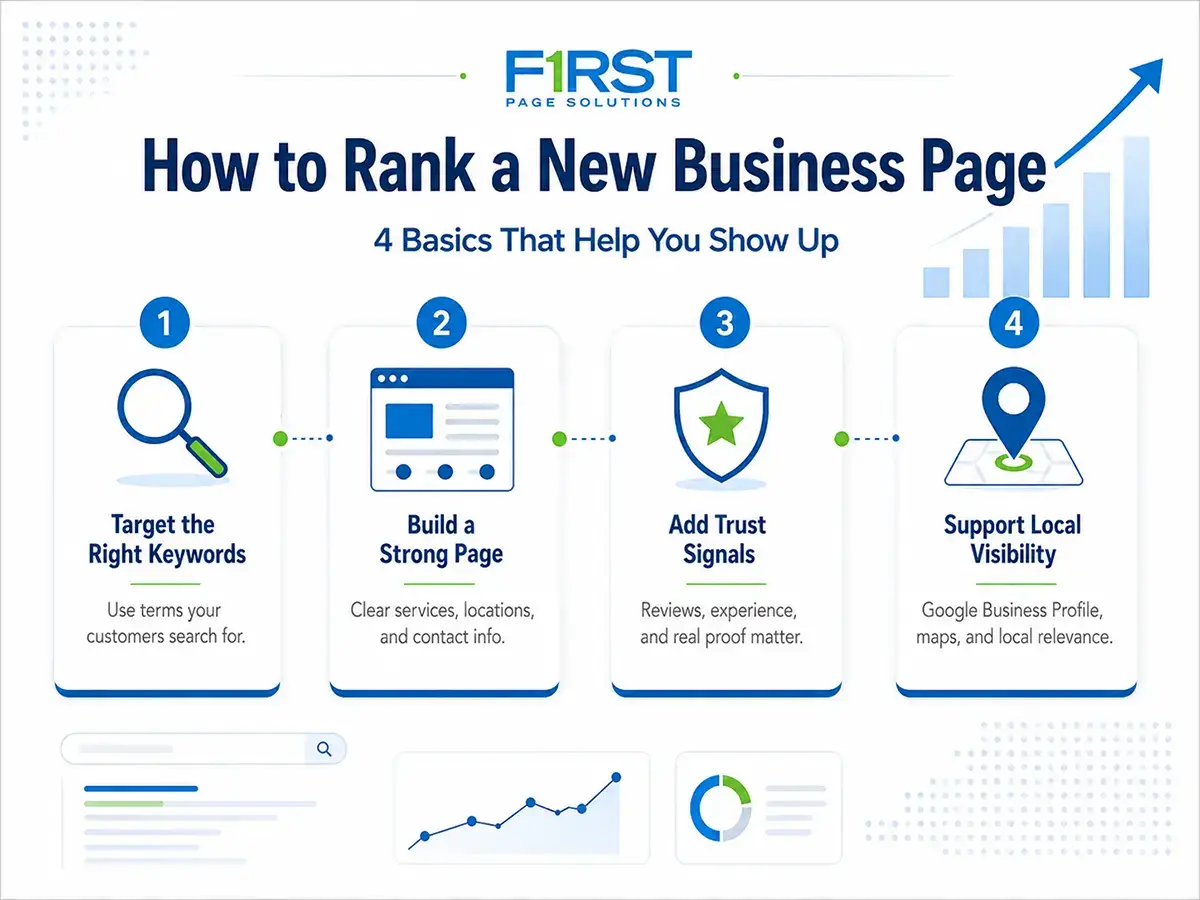
Google’s public guidance is the right starting point, but the value is not in knowing the checklist. Most business owners already know they need correct hours, reviews, photos, categories, and a verified profile. The value is in understanding why those basics affect trust, how small inconsistencies create ranking and conversion problems, and when a “complete” profile still fails to support real lead generation.
A Google Business Profile works best when every visible detail confirms the same business story. The name should match the real business. The category should match the service customers are most likely to search for. The address or service-area setup should match how the company actually serves people. The phone number, website, hours, photos, reviews, and services should all point in the same direction. When those pieces conflict, the profile may still look finished, but it becomes harder for Google and customers to trust.
The most important basics are not tasks to check off. They are trust signals that need to work together:
- The business name should match the real-world name customers see on the website, invoices, signage, vehicles, and other public references.
- The primary category should reflect the main service people search for, not the broadest possible description of the company.
- The secondary categories should support real services, not every possible keyword the business wants to rank for.
- The address or service-area setup should match whether customers visit the business or the business travels to them.
- The hours should match when someone can actually reach the business, especially if calls, appointments, or emergency services matter.
- The website link should send people to a page that answers their next question, not only the homepage by default.
- The photos should prove the business is real, active, local, and relevant to the service being offered.
- The reviews should show real customer experiences, not only star ratings.
- The owner’s responses should reinforce the service, location, and customer outcome naturally.
This is where experience matters. A contractor in Tottenville, a dentist in Great Kills, a med spa in New Dorp, and a restaurant in St. George all need accurate profiles, but they do not need the same profile strategy. A service business may need greater clarity on its service area and job-site photos. A medical office may need appointment confidence, review trust, and category precision. A restaurant may need hours, photos, menus, and to review freshness. The basics are the same on paper, but how they affect customer decisions varies by business type.
What Google Doesn’t Tell You to Try
Google does not tell you which parts of your local presence deserve the most attention. It gives rules, but it does not give business-specific judgment. A Staten Island law firm, roofer, med spa, restaurant, dentist, and restoration company each have different services, competitors, review patterns, urgency levels, and customer behavior. The work after the checklist is figuring out which details move customers closer to action.
The most useful local SEO work happens when a business tests the parts of the search experience that influence calls, bookings, direction requests, and quote requests. These are not shortcuts. They are practical adjustments based on how people respond to the profile, the website, the reviews, and the proof around the business. That is where local SEO becomes more than maintenance.
Track Google Business Profile Traffic Separately
The first thing a business should do is separate Google Business Profile traffic from regular organic traffic. Without that separation, the business may not know whether its profile is sending useful visitors to the website. Profile clicks can get buried in general organic traffic, which makes reporting look cleaner than it really is. A UTM-tagged website link helps show which visits came from the Business Profile and what those visitors did next.
This gives the business proof rather than guesswork. If profile visitors land on the site and leave quickly, the page may not answer the right question. If they click through but do not call, the call path or offer may be weak. If one service page gets strong engagement while another produces nothing, the business has a clearer next move. Tracking does not create leads on its own, but it shows where the local search system is working and where it is leaking.
Test Which Services Need Stronger Pages
Google lets you list services, but it does not tell you which services deserve full pages. Some services need standalone pages because customers search for them directly and need detailed answers before contacting the business. Other services belong inside a broader page because they support the offer but do not create enough demand on their own. Treating every service the same creates thin pages, weak priorities, and unclear messaging.
This matters for Staten Island businesses because demand is not always even across the borough. A service may draw stronger interest from one neighborhood, customer type, or season. The proof comes from impressions, clicks, rankings, form fills, calls, and lead quality. If a service keeps showing search activity but does not convert, the page may need clearer proof, better local context, stronger FAQs, sharper photos, or a more direct call to action.
Make Reviews More Specific
Google tells businesses to get reviews, but it does not explain how much review quality affects customer trust. A generic review that says “great company” helps a little. A specific review that mentions the service, problem, neighborhood, response time, staff, or outcome helps more because it answers the next customer’s hidden question: Can this business solve my problem?
The action is simple. Do not script reviews, but ask customers to describe what they hired you for and what helped them most. A Staten Island homeowner, patient, diner, or client should be able to read the review and understand what happened. Owner responses should also add context without sounding stuffed or fake. A strong response confirms the service, thanks the customer, and reinforces the real experience in plain language.
Use Photos That Prove The Business Is Real
Google says to add photos, but not every photo builds trust. Stock-style images, empty graphics, and generic building shots do not prove much. Real photos help customers see the business behind the listing. They also reduce the doubt that often happens before a person calls, books, or visits.
The best photos depend on the business. A contractor should show work, vehicles, crews, tools, and job details. A medical or wellness office should show the space, treatment rooms, staff, and appointment environment. A restaurant should show food, seating, signage, storefront, and current experience. For a Staten Island business, local proof matters because customers want to know whether the company is actually nearby, active, and relevant to the borough.
What These Tests Show Together
These steps work because they connect visibility to customer behavior. Tracking shows where leads come from. Service page testing shows what people want. Specific reviews show why customers trust you. Real photos show that the business exists, operates, and serves people locally. Each piece answers a different part of the customer’s decision.
This is the difference between a completed profile and a working local SEO system:
| What You Check | What It Tells You | What To Do Next |
| Business Profile traffic | Whether the profile sends useful visitors | Improve the linked page, call path, or offer |
| Service page performance | Which services create demand | Expand, combine, or rewrite pages based on real behavior |
| Review detail | Whether customers explain why they trusted you | Ask better review prompts without scripting responses |
| Photo engagement and quality | Whether the business looks real and active | Add clearer proof of staff, work, space, vehicles, or service areas |
| Calls and form fills. | Whether visibility becomes action | Fix weak pages, unclear CTAs, or poor intake paths |
A completed profile says the business exists. A working local SEO system shows whether people find it, trust it, visit the site, call the office, request a quote, or book an appointment. For Staten Island businesses, that difference matters because customers often search with both borough-level and neighborhood-level intent. They want someone close enough, credible enough, and clear enough to contact now.
Local Visibility Needs More Than A Finished Profile
A finished Google Business Profile is not the same as a working local SEO system. Staten Island customers often search with borough-level awareness and neighborhood-level intent, which means they want a business that looks real, nearby, responsive, and relevant to their problem.
Testing shows whether your profile, pages, reviews, photos, and tracking help people trust you enough to call, book, visit, or request a quote. The goal is not to chase tricks or copy competitors. The goal is to build a local presence that proves your business, earns trust, and improves based on what Staten Island customers do.